
Compliance documents are usually requested at the point of maximum pressure: the artwork is final, the printer is waiting, and someone asks for the ingredient declaration. The fix is not more paperwork but an earlier sequence. Custom perfume compliance is a small, predictable set of documents, and every one of them can be requested during development for a fraction of the cost of requesting it during a launch.
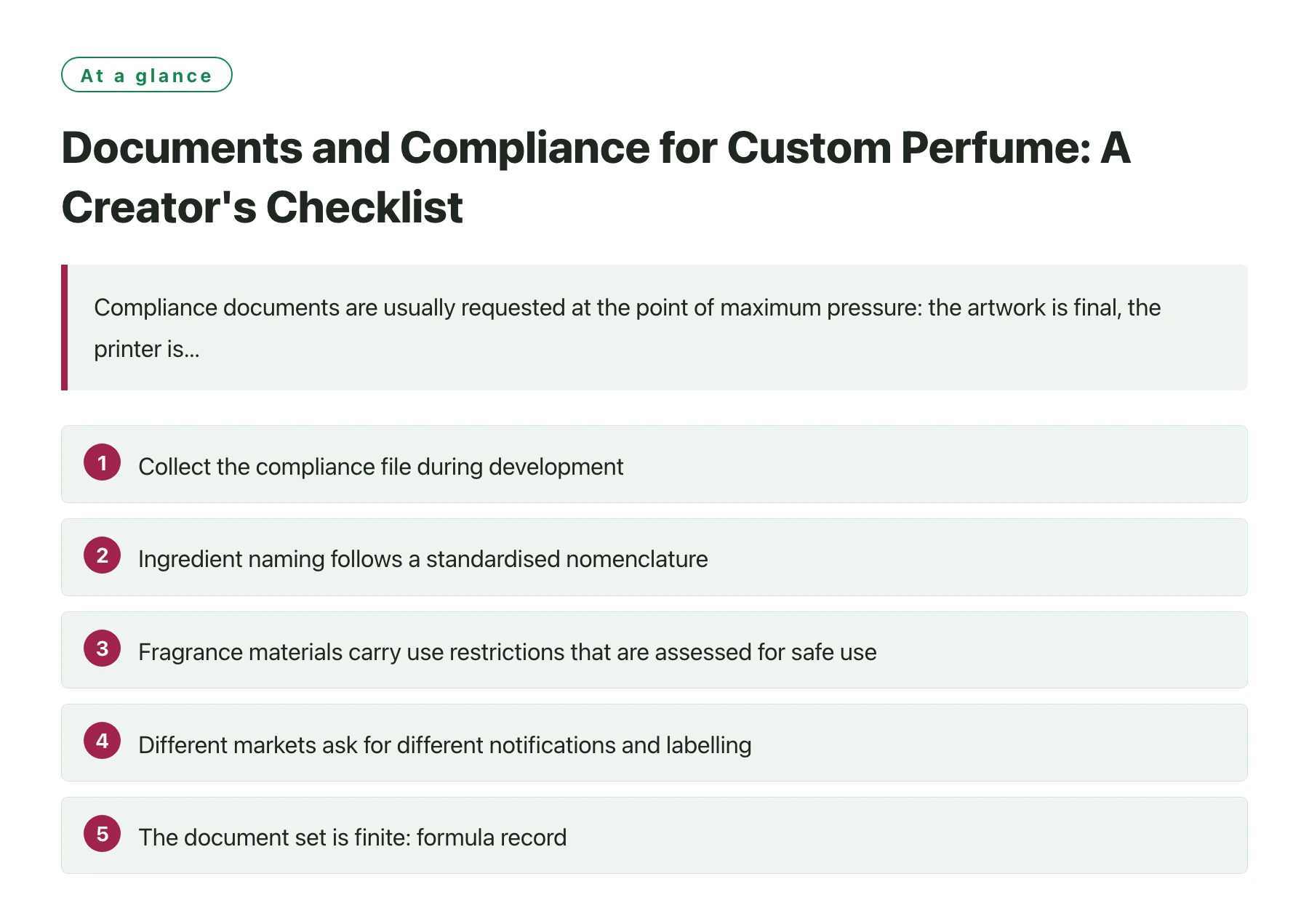
Key takeawaysCollect the compliance file during development, when a supplier can still adjust a formula, rather than during artwork approval when nothing can move. · Ingredient naming follows a standardised nomenclature, so the names on a label should be traceable to a published ingredient database rather than to a supplier's shorthand [1]. · Fragrance materials carry use restrictions that are assessed for safe use, which is why a restriction statement belongs with the formula instead of in a drawer [2]. · Different markets ask for different notifications and labelling, and a brand selling into more than one country needs the differences mapped before printing [3]. · The document set is finite: formula record, restriction and allergen statement, safety assessment or its reference, ingredient declaration, stability and compatibility results, artwork version, and batch records for each run.
The scenario repeats often enough to be predictable. A creator has spent four months on a scent, the bottle and the label artwork are approved, the printer has a slot booked, and a question arrives from the fulfilment partner: can we have the ingredient declaration and the safety documentation? The supplier can produce both, but the answers change the label, and the label change moves the print slot.
None of this is exotic. It is the ordinary friction of a project that treated compliance as a final step rather than as a design constraint. A fragrance formula determines what must appear on a label; a label determines what can be printed; a print slot determines whether the launch date holds. The documents sit at the front of that chain, not at the end.
This checklist is written for a creator-led launch with a single hero product and one or two markets, although the same list scales to a larger range. It names each document, what it covers, and the moment in the project when it should be requested.
The compliance file, document by document
| Document | What it covers | When to request it |
|---|---|---|
| Formula record | The composition version, its materials and their proportions, held by the party that compounds the scent | At the point the candidate formula is selected, before any label work begins |
| Restriction and allergen statement | Which materials in the formula carry use limits and which allergens must be declared, for the product category being made | During development, so a disputed material can still be substituted |
| Safety assessment or its reference | The cosmetic safety assessment covering the finished product, or the reference that shows where it is held | Before the first production run is scheduled |
| Ingredient declaration | The ingredient list in the correct order and nomenclature for the market of sale | Before artwork is finalised, because it drives the label layout |
| Stability and compatibility results | How the scent behaves in the actual product base and packaging over time and at temperature | After the fill formula is frozen and before bulk production is released |
| Artwork version record | The approved label version, its revision history and the date each revision was signed off | At every revision, not once at the end |
| Batch records and retained reference | How each production run was made, and the retained sample it is compared against at reorder | With every production run, including the first |
Seven documents is not a heavy file. What makes it feel heavy is requesting all seven in the same week. Spread across a normal development schedule, each one arrives when it is still cheap to act on it, and the file builds itself. That is also the practical test of a development partner: a factory that manages custom fragrance R&D and production as a staged programme will hand these documents over at the stage where they belong.
Where compliance quietly slips in a creator-led project
Three patterns account for most of the avoidable delay.
The first is a label designed before the formula is fixed. Designers work from a mock-up ingredient list, the artwork is signed, and the real declaration arrives later with a different number of allergen entries. The layout then has to be reopened, and a reopened layout rarely costs only the design hours.
The second is a formula adjusted after the compliance work was done. A note is softened at the fifth sample round, and the restriction statement now describes a formula that no longer exists. Re-running the documentation is straightforward; discovering the mismatch after printing is not.
The third is a market added late. A creator who starts with one market and adds a second before launch may find that the ingredient nomenclature and the notification requirements differ, and that the label needs a different layout for each. Ingredient names are standardised through a published database, which is what makes it possible to check a declaration rather than trust it [1].
Why the restriction statement is not a formality
Fragrance materials are assessed for safe use, and the limits attached to them depend on the product category and the concentration in the finished product [2]. A scent designed for a fine fragrance is not automatically suitable for a body lotion at the same dosage. The statement that accompanies a formula is therefore a design input: it tells a formulator how much room is left and which materials are close to a limit.
For a creator launch with one hero product, the statement is short. Its value is that it converts an invisible constraint into a written one, which is what makes the difference when the second product in the range is planned.
Markets differ, and the differences are documented
Cosmetic requirements are published in most major markets, and the differences are practical rather than philosophical: what must be notified, what must be declared, and which claims require substantiation. Health Canada's cosmetic safety guidance is a representative example of how a regulator sets out those expectations in plain terms [3].
The practical approach is to decide the market list before the label is designed and to ask a supplier to map the differences for that specific list. A supplier that has exported regularly will usually have the mapping already; one that has not will discover it with you.
If the launch schedule is tight, do one thing before anything else: ask for the ingredient declaration and the restriction statement on the day the formula is selected, not when the artwork is approved. Everything else in this checklist can be handled later without moving a print slot. A partner such as Xuelei that runs development, compounding and filling as one programme can usually produce the pair within the same milestone, and its background and certifications is the reason to be confident about the format they arrive in.
Sources
- EU CosIng — Cosmetic Ingredient Database (European Commission) —— The European Commission's CosIng database of cosmetic ingredients, listing ingredient functions, restrictions and labelling requirements under EU cosmetics law.
- IFRA: Safe Use and Fragrance Science —— IFRA's explanation of how fragrance materials are scientifically assessed for safe use and how those conclusions are applied by the industry.
- Health Canada: Cosmetic Safety —— Health Canada's cosmetics pages, covering cosmetic notification, the ingredient hotlist and safety requirements for cosmetics sold in Canada.
Frequently asked questions
Who is responsible for the cosmetic safety assessment?
Responsibility sits with the party placing the product on the market in most jurisdictions, which for an own-brand launch is usually the brand rather than the factory. The factory contributes the formula information and the material documentation that the assessment draws on, so the practical answer is that both sides have work to do and the split should be agreed in writing.
Can a supplier refuse to share the full formula?
Suppliers commonly share the compliance-relevant parts of a formula rather than the complete composition, which is enough for assessment, labelling and audit purposes. If a supplier will not share enough to support a safety assessment or an ingredient declaration, that is a boundary worth understanding before the order is placed.
How long does it take to produce the compliance file?
The documents are quick to issue once the formula is frozen; the slow part is the testing that some of them depend on. Stability and compatibility work needs calendar time, so the schedule should treat it as a task with a duration rather than as an administrative step.
Does an influencer launch need anything a conventional launch does not?
The documentation is the same. What differs is the audience: a creator community will ask direct questions about ingredients and safety, and having the documents on hand turns those questions into straightforward answers rather than referrals back to the factory.
What should be kept after the launch?
Keep the approved artwork version, the compliance file for each formula version, the batch records for every run, and the retained reference sample. Between them they cover retail listings, marketplace requests and any later comparison of a reorder against the original.