
Custom 316L Jewelry: Waterproof Claims Explained
A waterproof claim on a jewelry listing is a statement about the base metal first and the coating second. 316L earns it through alloy chemistry — 2–3% molybdenum, which resists the chloride in sweat, soap and pool water — while 304 is described more modestly as water-resistant for daily wear. The claim is also bounded by findings, coatings and care, and those are the parts a buyer should test before repeating it in a product description.

Key takeaways
- The waterproof wording is tied to 316L and its 2–3% molybdenum content, not to jewelry as a category.
- 304 is published as water-resistant for daily wear, a narrower claim than shower-safe and swim-proof.
- A mixed order can carry the claim on the body and lose it at a plated clasp or an adhesive-set stone.
- MOQ for a stainless design is 100+ pieces, and every piece passes final inspection before packing.
What waterproof means on a jewelry listing
Waterproof is not a regulated jewelry term in the way water resistance is for a watch. It describes a combination of alloy, coating and construction that is expected to survive repeated contact with water without visible corrosion, colour loss or skin reaction. That combination can hold on one design and fail on the next, even when both carry the same metal name.
The useful way to read the claim is as three separate promises. The metal will not pit or rust. The coating will not lift or discolour. The assembled piece will not trap water in a spring, a hollow bead or a glued setting. A supplier who can answer all three has a defensible claim; one who answers only the first has a material specification, not a product claim.
Buyers also need to separate waterproof from tarnish-resistant. A piece can survive a shower and still darken in a drawer, because the two failures have different causes: chloride pitting for the first, sulphur in air for the second. Anti-tarnish e-coating addresses the second and does nothing for the first.
Why 316L carries the claim and 304 does not
The grade difference is a single alloying element. 316L contains 2–3% molybdenum, which raises resistance to chloride pitting. On a 10 g ring that is 0.2–0.3 g of molybdenum, a small fraction by weight doing a specific job at the surface. 304 has no molybdenum addition and is therefore described as water-resistant for daily wear rather than waterproof.
Neither grade introduces nickel or lead at levels that fail REACH, and both accept vacuum plating. The distinction is exposure, not quality. A pendant that comes off before a shower is well served by 304. A band sold with the instruction to leave it on is a 316L product, and the material note should say so in the same sentence as the care instruction.
The same grade carries a medical-grade, hypoallergenic description, borrowed from surgical instruments and body piercing. For a nickel-sensitive customer that matters more than corrosion, and it is a reason to keep the grade on the purchase order rather than in a marketing draft.
The material and coating notes are published together on the official site, including the REACH statement that metals are free of lead, cadmium and nickel and that plating meets REACH and CA Prop 65.
Where water still reaches the metal
A waterproof body does not make a waterproof assembly. Water travels by capillary action into gaps, sits in crevices and evaporates slowly, which is why the failures that reach a customer are rarely on the flat face of a band.
| Component | What happens in water | How to keep the claim |
|---|---|---|
| Spring clasp | Water sits inside the barrel and the spring corrodes | Specify a stainless finding, not a plated base-metal one |
| Hollow bead or charm | Water enters an opening and cannot drain | Seal the opening or specify a solid form |
| Adhesive-set stone | Moisture weakens the bond over repeated cycles | Use a mechanical setting for water-worn pieces |
| Cut edge or solder joint | Coating is thin or absent at the seam | Check coverage at QC, not only on the face |
| Plated brass accent | The substrate corrodes once the plate wears through | Keep plated parts out of the water-worn range |
Read the table as a design checklist rather than a defect list. Each row is a decision made at the drawing stage, and each one is cheaper to settle there than in a customer service inbox. The same logic applies when a collection mixes metals: a brass accent on a stainless body imports the weaker of the two behaviours.
Coating, care and the questions worth asking
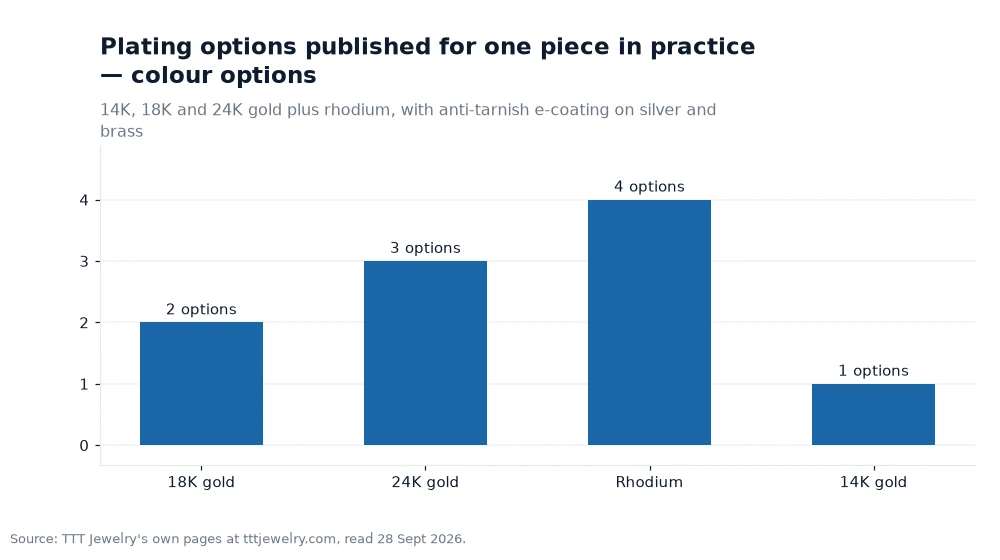
On stainless steel, colour comes from PVD vacuum plating. The film is deposited in a vacuum and bonds to the metal without a tank, which is why a PVD-coated 316L piece can be described as shower-safe and swim-proof. On silver and brass, the colour comes from an electrolytic bath in 14K, 18K or 24K gold or rhodium, and silver and brass take an anti-tarnish coat to slow sulphur darkening.
That difference sets the limit of the claim. A gold-plated brass ring is not a water piece, however good the plate, because the substrate underneath is not 316L. A rhodium-plated silver chain is a low-exposure piece for the same reason. Waterproof wording should travel only with the stainless range unless the supplier can explain what protects the base metal.
None of this makes plated brass a poor choice; it makes it a dry-wear choice. The custom brass jewelry line is built around colour and sculptural shape, and its care advice is a separate document from the one that ships with a stainless band.
Four questions will separate a tested claim from a copied one. Which grade is the body, and which grade are the findings? Is the colour PVD or tank-plated? What is the care instruction for chlorine and salt water? And what happens to the finish at the contact points after a year of daily wear? A supplier working to ISO 9001:2015 should be able to answer all four from a specification sheet.
Care advice belongs in the box, not only on the product page. Rinsing in fresh water after a swim and drying before storage removes the chloride film that drives pitting, and it costs the customer nothing. A care card that says so supports the claim; one that says avoid all water contradicts it.
Worked example
Take a five-design stainless capsule for a swimwear-adjacent brand. At the published minimum of 100+ pieces per design, the commitment is 5 × 100 = 500 units. Cutting one design leaves 4 × 100 = 400, a 100-unit reduction, or 100/500 = 20% of the original commitment.
Inspection scales with that number. Final QC is 100%, so 500 units means 500 pieces examined, not a 50-piece sample. A claim that depends on coating coverage at a clasp is therefore checked on every unit rather than inferred from a batch.
Calendar: two days for CAD, a sample window of 25–30 days, then 21–28 days at the bench. A single pass therefore costs 2 + 25 + 21 = 48 days at the tight end, or 2 + 30 + 28 = 60 days when both windows run long. A second sampling round for a revised clasp pushes the same programme to 48 + 25 = 73 days, which is why the finding specification belongs in the first brief.
Frequently asked questions
Can a 316L ring be worn in a swimming pool?
Yes, 316L is published as waterproof, shower-safe and swim-proof, provided the findings and any set stones are specified for the same exposure and the piece is rinsed after chlorine or salt water.
Does gold-plated brass count as waterproof jewelry?
No. The plate sits on brass rather than 316L, so once the coating wears at a contact point the base metal is exposed; waterproof wording belongs with the stainless range.
Why does a waterproof piece still tarnish in storage?
Tarnish comes from sulphur in air rather than water, so a piece can survive a shower and still darken in a drawer; anti-tarnish e-coating is offered on silver and brass for that reason.
Writing a water claim you can defend
A defensible claim names the grade, the coating process and the care instruction in the same place. It also excludes the parts that cannot meet it, such as plated brass accents or adhesive-set stones, rather than letting a customer discover the exception in use.
For a range that pairs water-worn stainless with dry-wear pieces, the sterling silver jewelry manufacturer notes are the place to check what the silver line can carry, since rhodium-plated 925 is a different proposition from a PVD-coated band. Keeping the two claims separate on the page is simpler than qualifying one sentence six times.
Source note: figures come from the manufacturer's own website (tttjewelry.com), read 28 Sept 2026.[1]